In the age of home computers, a goal for many of us was to build “something smart” on the limited devices we had available. Often, this was dreams of an “electronic brain” or, more realistically and feasible: (discrete) simulations and basic PID controllers.
At last, the work has reached the stage where the actual experiments can begin.
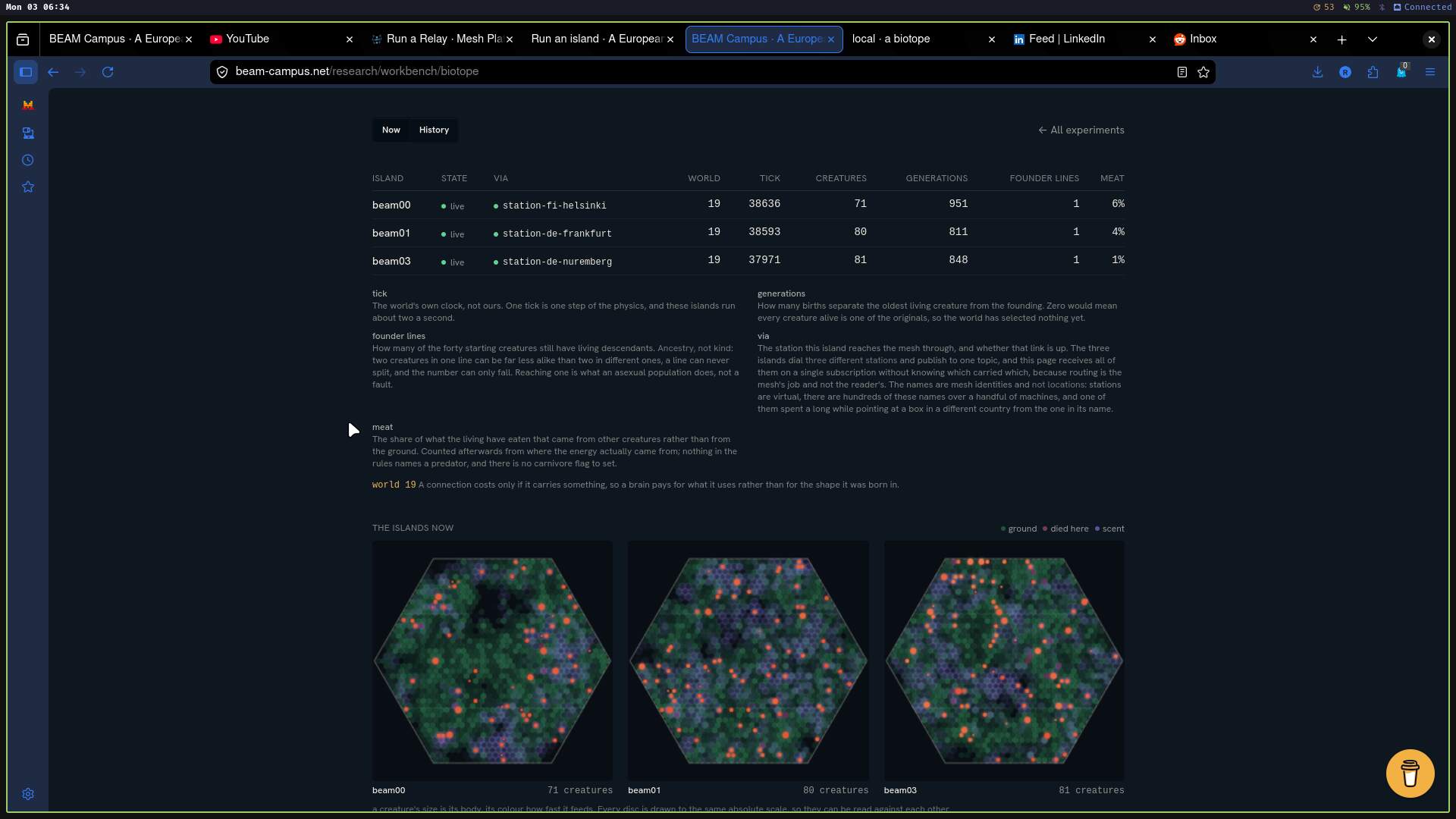
By combining the capabilities of #Erlang and the foundational work by Gene Sher, PhD on #TWEANN and #Neuroevolution, I can now present a decentralized platform for research into #ArtificialLife.
The attached screenshot shows 3 Islands: each running on a separate node and connected (via the #Macula Mesh) to each other and the visualization site at beam-campus.net, which offers a real-time dashboard on the activity on these islands.
The point is to let populations evolve and adapt and -hopefully- discover new capabilities (aka #NoveltySearch) which are beneficial to their survival.
When defining such an environment, it is important not to steer towards a desired outcome (#OpenEndedness), so the definition of the engine must not be biased towards biological, chemical or other high-level principles. Therefor, in this first iteration, the only principles in play can be the Laws of Thermodynamics.
An upcoming experiment is to actually let a population from one island migrate to another island, “over-the-mesh”.
Calling all enthusiasts to run a biotope container on an old laptop and thus contribute to our search for #ALife.
check out Biotopes on the BEAM to get involved!